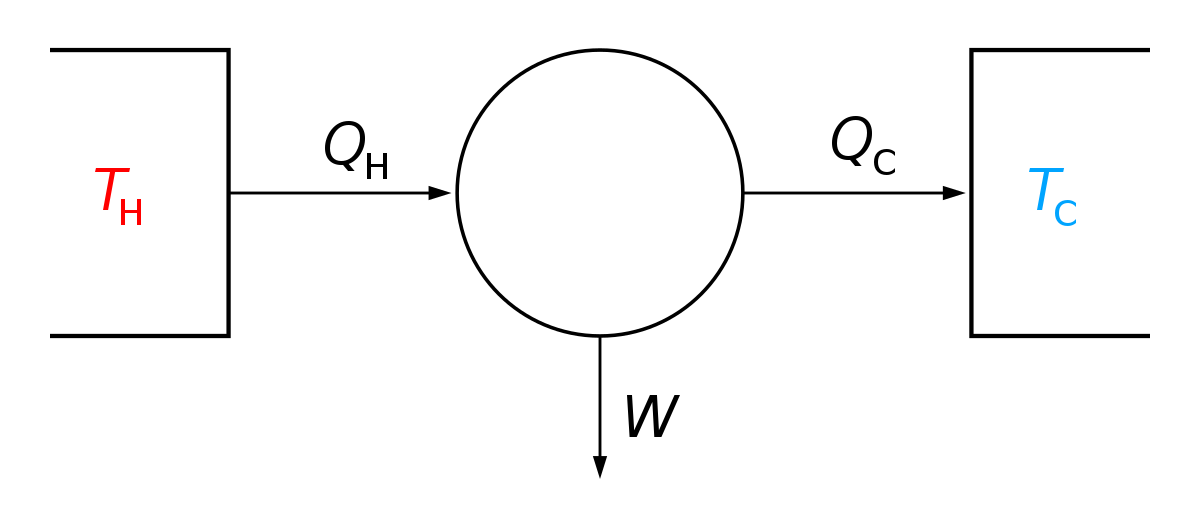
Sadi Carnot and the Perfect Engine
Carnot's achievement was remarkable because thermodynamics as a formal science didn't yet exist when he wrote his book. He used the caloric theory of heat — the mistaken idea that heat was a conserved fluid — yet his analysis of engine efficiency was completely correct and survived the eventual replacement of caloric theory by kinetic theory intact. His argument was elegantly general: any reversible heat engine operating between the same two temperatures must have the same efficiency, regardless of the working fluid or design. The maximum achievable efficiency depends only on the temperatures: To improve efficiency, you either raise the source temperature or lower the sink temperature. Materials science — not thermodynamics — sets the practical upper bound on combustion temperature, which is why advanced turbine blade cooling and ceramic materials research directly translates to higher power plant efficiency.
The Second Law: Why Some Heat Must Always Be Rejected
The Second Law of Thermodynamics has many equivalent statements. The most useful for engineering: no process is possible whose sole effect is the conversion of heat into work. Some heat must always be rejected to a cold reservoir. This is not an engineering limitation — it is a statement about entropy. A heat engine takes entropy at high temperature and expels it at low temperature, extracting work in the process. The minimum heat rejected is determined by entropy conservation. A device that extracts work from a single heat reservoir without rejecting heat would not violate energy conservation (First Law) but would violate entropy conservation (Second Law). Such a "perpetual motion machine of the second kind" is impossible. Many patents have been filed for such devices; all are fraudulent or mistaken.
The Otto Cycle: What Your Car Engine Does
The idealised model of a petrol internal combustion engine is the Otto cycle. It consists of isentropic compression, constant-volume heat addition (spark ignition), isentropic expansion (power stroke), and constant-volume heat rejection (exhaust). The efficiency depends only on the compression ratio r:
The Diesel Cycle: Compression Ignition
Rudolf Diesel's 1892 engine compressed air so much that its temperature exceeded the fuel's ignition point — no spark needed. Heat addition occurs at constant pressure as the piston moves down. Diesel engines use compression ratios of 14–25 (vs 8–12 for Otto) and achieve real-world efficiencies of 35–45%, higher than petrol engines, which is why diesel dominates heavy transport and shipping.
Power Plants and the Combined Cycle
Stationary power plants can exploit more complex thermodynamic cycles unconstrained by weight and size requirements. The most efficient technology currently deployed is the combined cycle gas turbine (CCGT): a Brayton cycle (gas turbine) extracts work from high-temperature combustion exhaust, which then drives a Rankine cycle (steam turbine). Overall efficiencies of 60–63% are achievable — compared to ~38–42% for simple steam cycles. For a 1 GW plant, this difference is worth hundreds of millions of dollars per year in fuel costs. Enter your compression ratio, heat addition, and temperature limits. EngForge computes the Otto or Diesel cycle efficiency, draws P-V and T-S diagrams, and shows the gap to the Carnot limit.