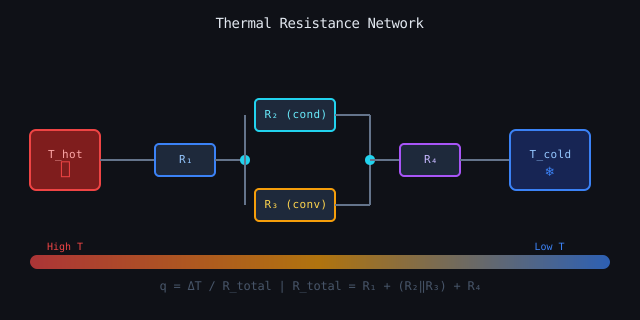
Conduction and thermal resistance
Fourier's law: q = −kA(dT/dx). Thermal resistance R = L/(kA) lets engineers treat heat flow like electrical current through a circuit.
- Series resistances add; parallel resistances reduce (like electrical circuits).
- High-conductivity materials (copper 400 W/m·K, aluminium 200 W/m·K) minimize resistance.
- Thermal interface materials reduce contact resistance at joint surfaces.
Convection and heat transfer coefficients
Newton's law of cooling: Q = hA(Ts − T∞). The convective coefficient h depends on geometry, fluid, and flow regime.
- Natural convection: h = 5–25 W/m²·K (air); forced convection: h = 25–250 W/m²·K.
- Use dimensionless Nusselt, Reynolds, and Prandtl numbers for correlation-based design.
- Fins increase effective area; optimize fin pitch with the efficiency ηf.
Heat exchanger sizing with LMTD
The log mean temperature difference method relates exchanger area to heat duty and overall transfer coefficient: Q = U·A·LMTD.
- Counterflow configuration gives higher LMTD than parallel flow for the same terminal temperatures.
- Overall U combines wall conduction and both convective resistances.
- Add 20–30% area margin for fouling allowance in process industry applications.