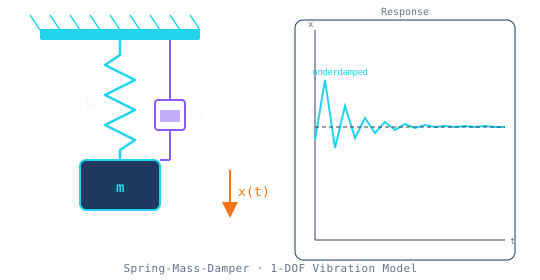
Equation of motion
The governing equation is m·ẍ + c·ẋ + k·x = F(t). Three parameters fully characterise the unforced response: natural frequency ωn, damped natural frequency ωd, and damping ratio ζ.
- Natural frequency: ωn = √(k/m) rad/s — independent of damping.
- Damping ratio: ζ = c / (2√(km)) — dimensionless measure of energy dissipation.
- Damped frequency: ωd = ωn√(1−ζ²) — what you actually observe in free vibration.
Damping regimes
The value of ζ determines whether the response overshoots (ζ<1), returns without oscillation (ζ≥1), or is critically damped at the boundary (ζ=1).
- Underdamped ζ < 1: oscillates with decaying amplitude — most engineering structures.
- Critically damped ζ = 1: fastest return to equilibrium without oscillation — preferred for instruments.
- Overdamped ζ > 1: slow exponential return — used in door closers and some shock absorbers.
Resonance and forcing
When sinusoidal forcing frequency equals the natural frequency, steady-state amplitude grows without bound in an undamped system. Damping limits this growth.
- Resonance amplification factor Q ≈ 1/(2ζ) — higher for lightly damped systems.
- The simulator warns when the forcing frequency is within 5% of ωn.
- Step forcing (sudden constant force) produces a transient overshoot of 2F₀/k for zero initial conditions.
Engineering applications
Vehicle suspensions, seismic base isolators, vibration absorbers, and machine mounts all use this model. Choosing ζ ≈ 0.6–0.7 gives the best compromise between speed and overshoot.
- Automotive suspension target: ζ ≈ 0.25–0.35 (comfort) to ζ ≈ 0.5–0.7 (handling).
- Seismic isolators target long natural period (0.5–2 Hz) to detune from ground motion spectrum.
- Vibration absorbers (tuned mass dampers) add a secondary mass-spring system to cancel resonance.