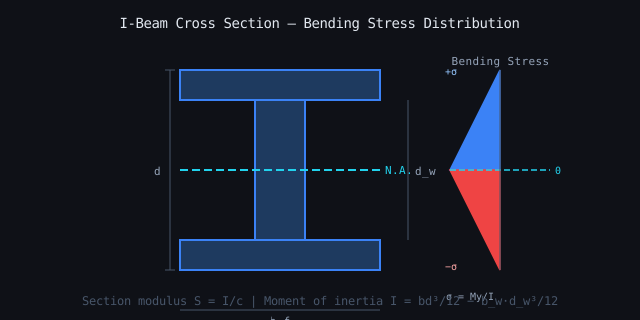
Moment of inertia and the parallel axis theorem
The second moment of area I measures a section's resistance to bending. The parallel axis theorem I = I_centroid + A·d² allows I to be calculated for composite sections.
- For a rectangle: I = bh³/12 about the centroidal axis.
- I-shaped sections: add flange and web contributions using parallel axis theorem.
- Holes and cutouts are subtracted, not added.
Section modulus and stress
Elastic section modulus S = I/y_max links bending moment directly to extreme fibre stress: σ = M/S. This is the key formula for beam strength checking.
- The plastic section modulus Z = Σ(A·y_bar) is used for ultimate strength design.
- Shape factor Z/S = 1.12 for I-sections, 1.5 for rectangles.
- Compact sections achieve Mp = Fy·Z; slender sections buckle before reaching Mp.
Torsion and warping
Open thin-walled sections (I-beams, channels) are very weak in torsion. Closed sections (HSS, box) resist torsion far more efficiently.
- Torsional constant J for open sections ≈ Σbt³/3.
- Saint-Venant torsion dominates in short members; warping torsion in long, open sections.
- Use HSS or box sections where torsion is significant; avoid channel beams in torsion.