Deterministic safety factors
Traditional design uses a single safety factor SF = mean capacity / mean demand, applied to allowable stress or load. This is simple but cannot quantify failure probability explicitly.
- Typical SF: 2–5 for static loads, higher for dynamic or uncertain loading.
- SF bundles together uncertainty in material, load, workmanship, and model accuracy.
- Global safety factor approach masks whether the design is load-uncertain or resistance-uncertain.
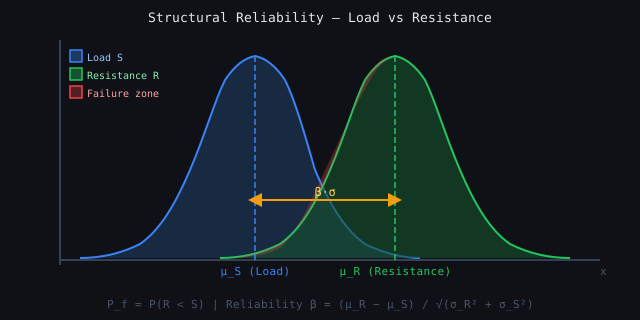
Probability-based design and reliability index β
Modern codes (Eurocode, ASCE 7, AS/NZS) use limit state design with partial factors calibrated to achieve a target reliability index β = 3.5–4.5 for ultimate states.
- β = (µR − µS) / √(σR² + σS²) — distance from failure in standard deviation units.
- Pf = Φ(−β) where Φ is the standard normal CDF.
- β = 3.5 → Pf ≈ 2×10⁻⁴ (annual for ultimate structural limit state).
Risk-informed decisions
Beyond structural reliability, consequence must be weighed against probability. Risk = P(failure) × Consequences drives cost-benefit optimization of safety investments.
- ALARP: risk must be As Low As Reasonably Practicable — not necessarily as low as possible.
- Fault trees and event trees combine component failure probabilities systematically.
- Target failure rates in code are implicit social decisions balancing economic and life-safety priorities.