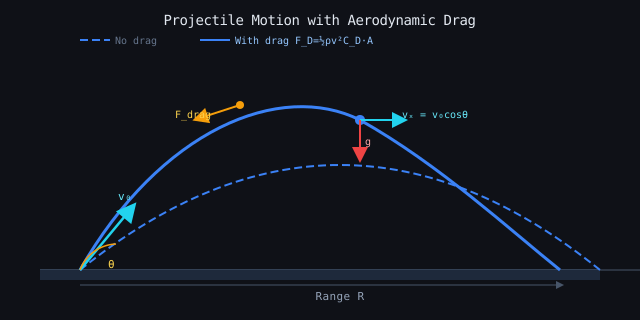
Quadratic drag force
At speeds above ~1 m/s (Re > ~1000), air resistance is proportional to the square of velocity: F_drag = ½ Cd ρ A v². This is the dominant drag regime for sports balls, artillery shells, and most engineering projectiles.
- Cd is the drag coefficient (sphere ≈ 0.47, streamlined body ≈ 0.05–0.15).
- ρ = 1.225 kg/m³ at sea level, 15°C — decreases with altitude.
- A is the cross-sectional area facing the flow direction.
Equations of motion
With drag, the equations of motion are coupled: ẍ = −(k·v)·vx and ÿ = −g − (k·v)·vy, where k = ½ Cd ρ A / m and v = √(vx² + vy²). No closed-form solution exists — numerical integration is required.
- The RK45 solver integrates all four state variables [x, vx, y, vy] simultaneously.
- Drag acts opposite to the instantaneous velocity vector, not just the horizontal direction.
- Impact speed is always less than initial speed due to energy dissipation by drag.
Effect on trajectory
Drag causes an asymmetric trajectory: the downward leg is steeper than the upward leg. The optimal angle for maximum range shifts below 45° and depends on the ballistic coefficient m/(Cd A).
- For a football (Cd≈0.2, m≈430 g): optimal angle ≈ 40–43°, range reduction ~15%.
- For a shot put (heavy, dense): drag effect is small, optimal angle close to 45°.
- The simulator shows drag-range loss as a percentage for direct comparison.