Darcy-Weisbach equation
Pressure drop along a pipe: ΔP = f · (L/D) · (ρv²/2). Head loss: hL = f · (L/D) · (v²/2g). The friction factor f is dimensionless and depends on flow regime and wall roughness.
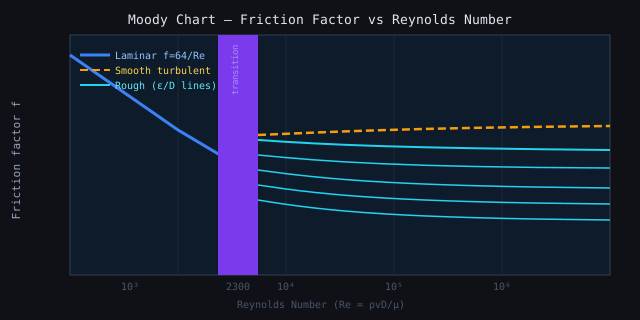
- Laminar flow (Re < 2300): f = 64/Re — exact, no roughness dependence.
- Turbulent flow (Re > 4000): f depends on both Re and relative roughness ε/D.
- Transitional zone (2300 < Re < 4000): f is uncertain — avoid in design if possible.
Colebrook-White equation
For turbulent flow, the Colebrook-White equation 1/√f = −2 log(ε/(3.7D) + 2.51/(Re√f)) is the most accurate model, matching the Moody chart. It is implicit in f and must be solved iteratively.
- The simulator uses Brent's method to converge to ±10⁻¹⁰ tolerance.
- Explicit Swamee-Jain approximation gives ±3% and avoids iteration.
- Pipe roughness ε: commercial steel 0.046 mm, galvanised steel 0.15 mm, PVC/glass ~0.002 mm.
Design implications
Pressure drop scales with v² — halving the velocity reduces friction losses by 75%. Minor losses at fittings and valves are added as equivalent lengths or K-factors.
- Velocity limits: 1.5–3 m/s for water to avoid erosion and noise.
- Pump sizing: total system curve (static head + friction) intersects pump curve at duty point.
- For compressible gas flow, use the Weymouth or Panhandle equations instead.