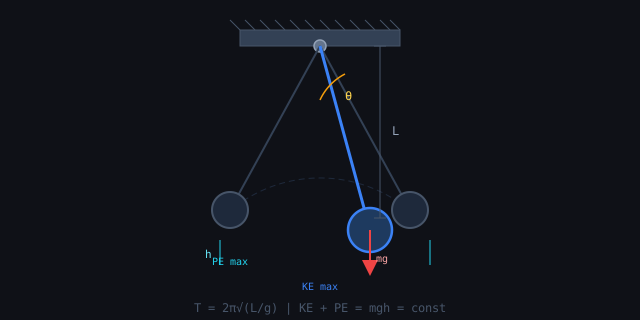
Small-angle approximation and SHM
For angles below ~10°, sinθ ≈ θ (in radians) and the restoring force is approximately linear — producing simple harmonic motion with period T = 2π√(L/g).
- Period depends only on length L and gravity g, not mass or (small) amplitude.
- Doubling L increases period by √2 ≈ 1.41.
- On the Moon (g ≈ 1.62 m/s²), a 1 m pendulum has period ≈ 4.95 s vs 2.0 s on Earth.
Large-angle correction
At amplitudes above 20°, the small-angle approximation fails and the true period is longer. Elliptic integral series give the correction.
- At 90° initial angle: true period ≈ 1.18× the small-angle result.
- At 30°: correction ≈ +1.7%; significant for precise timekeeping.
- Huygens' tautochronism: a cycloidal path, not circular, gives perfect isochronism.
Damping and energy loss
Real pendulums lose energy to air drag and pivot friction, causing exponentially decaying amplitude. Damping ratio ζ classifies the oscillation regime.
- Underdamped (ζ < 1): oscillates with decaying amplitude — typical pendulums.
- Critically damped (ζ = 1): returns to rest fastest without oscillation.
- Quality factor Q = π/δ where δ is the logarithmic decrement between successive swings.