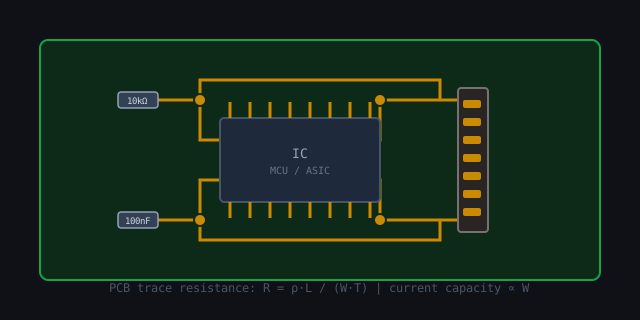
Trace current capacity and thermal rise
IPC-2221 provides charts for allowable temperature rise vs cross-section (width × thickness). External traces can handle 50–100% more than internal traces at the same temperature rise.
- Rule of thumb: 1 oz copper (35 µm) external trace 1 mm wide handles ~1 A at 10°C rise.
- Shorter traces and via transitions behave like point heat sources — check local hot spots.
- Copper pours and thermal relief spokes both affect heat spreading path.
Controlled impedance for high-speed signals
Signals above 200 MHz or with rise times below 1 ns need traces designed as transmission lines to prevent reflections and signal distortion.
- Microstrip characteristic impedance depends on trace width, height above reference plane, and dielectric constant (εr).
- Typical target: 50 Ω single-ended, 100 Ω differential.
- Maintain consistent reference plane under high-speed traces; voids cause impedance discontinuities.
EMC layout strategy
Most EMC problems are caused by layout, not component selection. Loop area reduction is the single most effective EMC technique.
- Return current follows path of least impedance (AC: directly beneath signal trace).
- Decouple power pins close to IC; X5R or X7R ceramics near pins, bulk electrolytic farther away.
- Separate analog and digital grounds, joining at a single star point.