Rate coding vs temporal coding
Rate coding assumes information is carried in the average firing rate over a time window. Temporal coding hypothesizes that precise spike timing carries additional information.
- Rate code is robust to noise but slow; temporal code is fast but fragile.
- Many sensory systems use rate coding at low precision; auditory timing uses sub-millisecond precision.
- Population coding distributes information across many neurons, providing redundancy and accuracy.
Poisson statistics and ISI analysis
Many neurons fire approximately as a Poisson process: spikes arrive randomly with a mean rate λ. The interspike interval (ISI) distribution is then exponential with CV = 1.
- Coefficient of variation CV = σ_ISI/μ_ISI characterizes spiking regularity.
- CV < 1: regular (pacemaker cells); CV = 1: Poisson random; CV > 1: bursty.
- Fano factor (variance/mean spike count) is 1 for pure Poisson — deviations indicate correlations.
Hodgkin-Huxley and action potential generation
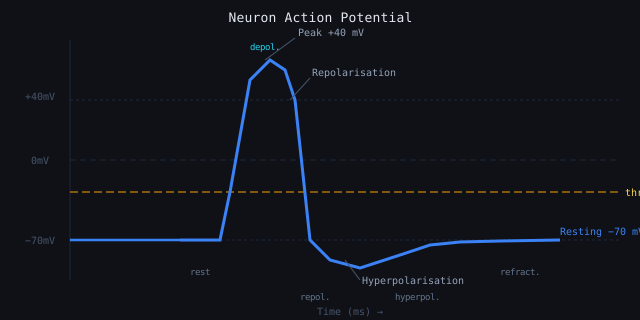
The Hodgkin-Huxley model describes action potential initiation through voltage-gated Na⁺ and K⁺ conductances. The threshold (~−55 mV) and absolute refractory period (~1–2 ms) are key constraints on spiking.
- Depolarization beyond threshold triggers regenerative Na⁺ influx — the all-or-nothing spike.
- K⁺ channels cause repolarization and hyperpolarization, imposing the refractory period.
- Myelination increases the length constant, enabling faster action potential propagation.