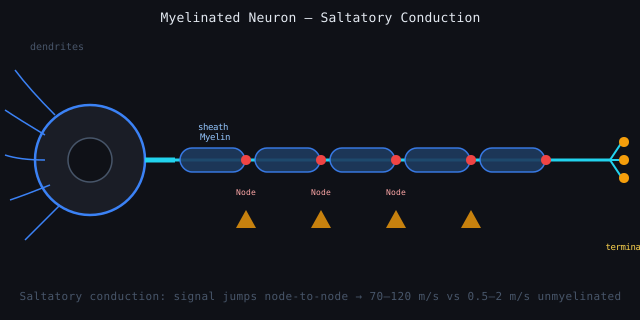
Saltatory conduction and myelination
Myelin sheath dramatically reduces membrane capacitance and increases resistance across internodal segments, forcing action potentials to regenerate only at the exposed nodes of Ranvier.
- Saltatory conduction is ~100× faster than conduction in equivalent unmyelinated fibers.
- Internode length scales with axon diameter — optimized to maximize conduction velocity.
- Myelination also reduces metabolic cost: Na/K-ATPase pumps needed only at nodes.
Nerve conduction studies
Clinical NCS measures conduction velocity, amplitude, and latency for sensory and motor nerves to diagnose neuropathies and localize lesions.
- Demyelination: normal amplitude but slowed NCV, prolonged distal latency, conduction block.
- Axonal loss: reduced amplitude with normal NCV — quantifies nerve fiber loss.
- F-wave and H-reflex test proximal conduction (root, plexus) not accessible by routine NCS.
Multiple sclerosis and Guillain-Barré
Multiple sclerosis (CNS demyelination) and Guillain-Barré syndrome (PNS demyelination) both slow conduction — but in different compartments with different clinical patterns.
- MS: oligodendrocyte damage leaves axons exposed; plaques slow or block conduction.
- GBS: anti-ganglioside antibodies attack peripheral myelin; NCS shows widespread slowing.
- Remyelination (Schwann cells more than oligodendrocytes) can restore significant function.