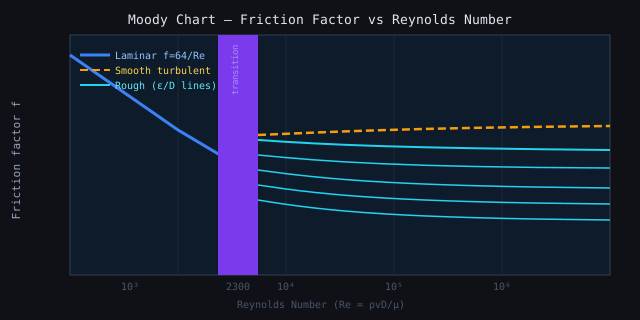
Reynolds number and flow regime
Re = ρvD/µ determines whether flow is laminar (Re < 2300), transitional, or turbulent (Re > 4000). This drives all subsequent friction factor calculations.
- Laminar flow: f = 64/Re (Hagen-Poiseuille; smooth, predictable).
- Turbulent flow: use Colebrook-White or Moody diagram.
- Most industrial pipe flows are turbulent; viscous fluids may be laminar near pumps.
Darcy-Weisbach and friction losses
hf = f·(L/D)·(v²/2g) is the Darcy-Weisbach equation for head loss. The friction factor f depends on relative pipe roughness ε/D and Reynolds number.
- Fully turbulent rough regime friction factor is independent of viscosity (high Re).
- Equivalent length method: convert fittings valves to pipe length for minor losses.
- Minor losses often dominate in compact piping with many fittings and valves.
System curve and pump integration
The system curve (H = static head + K·Q²) across the range of flow rates defines operating locus for the pump curve intersection.
- Operating point shifts right with reduced static head and left with added resistance.
- Check for minimum flow and runout conditions on the pump curve.
- Series pumps add head at the same flow; parallel pumps add flow at the same head.