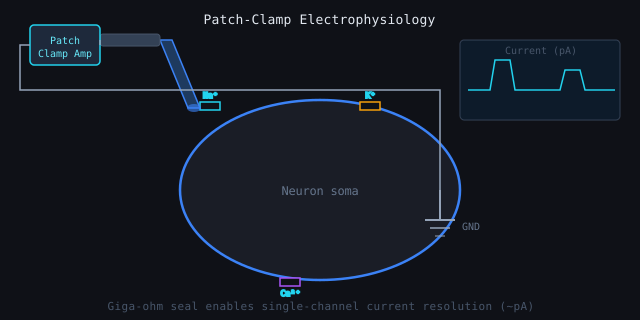
Patch clamp and single-cell precision
The patch clamp technique (Neher & Sakmann, 1976) forms a gigaohm seal between a glass pipette and the cell membrane, enabling recording of single ion channels or whole-cell currents.
- Whole-cell recording: access to intracellular contents; measure all ion channels together.
- Cell-attached: non-invasive single-channel recording under physiological conditions.
- Voltage-clamp mode: hold membrane potential fixed to isolate specific ion channel currents.
Multi-electrode arrays and silicon probes
MEAs and high-density silicon probes (e.g., Neuropixels) record simultaneously from tens to thousands of neurons across brain regions.
- Local field potential (LFP) reflects synchronized activity of local neural populations.
- Unit isolation (spike sorting) requires careful offline analysis — principal components and template matching.
- Chronic implants drift over weeks; impedance rise from glial scarring reduces signal quality.
EEG: spatial averaging of brain activity
EEG records scalp potentials generated by synchronous post-synaptic currents in cortical pyramidal neurons. It has excellent temporal resolution (ms) but poor spatial resolution (cm).
- Source localization (LORETA, beamforming) estimates current sources from scalp distribution.
- Common reference choice (average reference, mastoid) significantly affects topographic maps.
- EEG frequency bands (delta, theta, alpha, beta, gamma) correlate with mental states and pathology.