Buckingham Pi theorem
If a physical equation involves n variables and k fundamental dimensions, it can be expressed in (n−k) independent dimensionless groups — dramatically reducing experimental complexity.
- Drag on a sphere: originally F, ρ, v, D, µ (5 variables, 3 dimensions) → 2 groups: Cd and Re.
- Choose repeating variables carefully to contain all fundamental dimensions.
- Dimensionless groups are not unique — different choices yield different but equivalent sets.
Key dimensionless numbers
Each classical dimensionless number captures a ratio of competing physical effects, enabling universal correlations across scales and fluids.
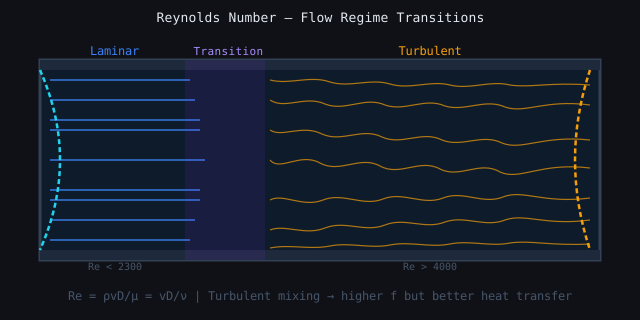
- Reynolds Re = ρvL/µ: inertia/viscosity — governs flow regime.
- Nusselt Nu = hL/k: convective/conductive heat transfer.
- Froude Fr = v/√(gL): inertia/gravity — governs open-channel and ship flows.
- Mach Ma = v/c: compressibility effects above Ma ≈ 0.3.
Scale model testing and similarity
For a scale model to accurately represent full-scale behavior, all relevant dimensionless groups must match between model and prototype — which is often impossible in practice.
- Wind tunnel testing: match Re (vary fluid properties or pressure) at reduced scale.
- Naval architecture: Froude similarity governs wave patterns; separate viscous corrections needed.
- Structural models: match geometry ratios; gravity similarity may require centrifuge.