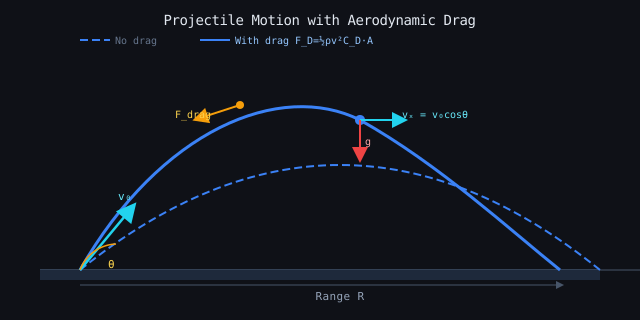
Kinematic equations and independence of motion
Projectile motion combines constant horizontal velocity (no horizontal force) with uniformly accelerated vertical motion. The two components are independent and solved separately.
- Horizontal: x = v₀cosθ · t (constant velocity)
- Vertical: y = v₀sinθ · t − ½gt² (under gravity)
- Time of flight: t = 2v₀sinθ/g for level ground launch and landing.
Range and optimal angle
Range R = v₀²sin(2θ)/g is maximized when θ = 45°. For targets above or below launch height, the optimal angle shifts.
- Maximum range at 45° on flat ground; increases with launch elevation.
- Complementary angles (e.g., 30° and 60°) give the same range on flat ground.
- In vacuum, range scales with v₀² — doubling speed quadruples range.
Air resistance and real trajectories
Real projectiles experience drag force proportional to velocity squared. This reduces range, lowers peak height, and makes the optimal angle less than 45°.
- Drag force FD = ½ρv²CdA; Cd depends on geometry and Mach number.
- Numerical integration (Euler or Runge-Kutta) is needed for accurate drag predictions.
- Spin-stabilized projectiles experience additional Magnus force causing curved paths.