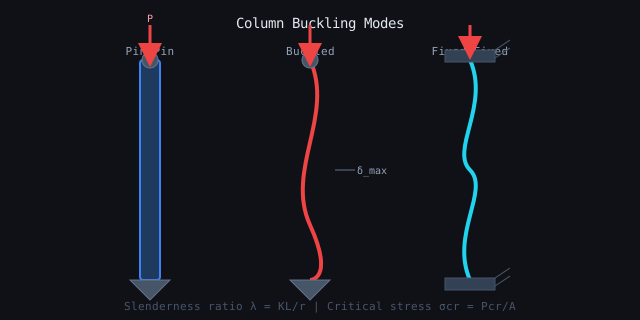
Euler critical load and effective length
Pcr = π²EI/(KL)² is Euler's formula for the critical buckling load. K is the effective length factor reflecting end conditions.
- K = 1.0 for pin-pin ends (theoretical), 0.7 for pin-fixed, 0.5 for fixed-fixed.
- Real connections are between pinned and fixed; codes provide K values for standard cases.
- Euler's formula assumes perfectly straight columns; real columns include Johnson's parabola for short columns.
Slenderness ratio and transition
Slenderness ratio λ = KL/r (r = radius of gyration). High λ → elastic buckling governs; low λ → yield governs; transition requires interaction.
- Steel columns with λ > 200 are generally too slender for efficient design.
- Code capacity reduction factors (φ) account for residual stresses and initial imperfections.
- Increase r by choosing hollow sections (HSS) or wide-flange columns with equal-leg proportions.
Combined axial and bending
Most building columns carry both axial load and bending moments from eccentric loads or lateral forces. Interaction equations limit combined stress.
- Steel interaction: Pu/φPc + Mu/φMp ≤ 1.0 (simplified form).
- Second-order effects (P-Δ and P-δ) amplify moments in slender columns.
- Use notional loads and direct analysis method per AISC 360 for frame stability.