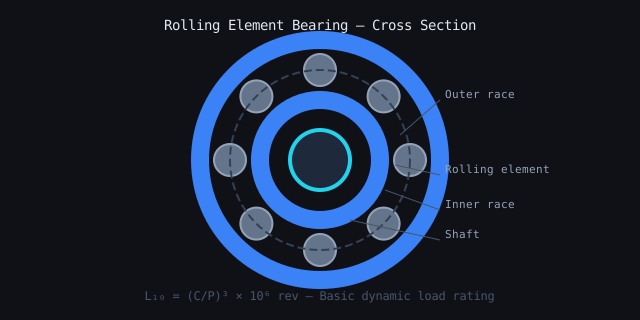
L10 life and the C/P ratio
The basic L10 life is the number of revolutions (or hours) that 90% of a bearing population will survive. L10 = (C/P)ᵖ millions of revolutions, where p = 3 for ball bearings.
- Dynamic load rating C is a catalog value; equivalent dynamic load P combines radial and axial forces.
- Doubling C/P increases L10 by 8× for ball bearings.
- Use the modified rating life formula to account for reliability, lubrication, and contamination.
Lubrication viscosity ratio
Adequate film thickness separates rolling elements from raceways. Viscosity ratio κ = ν/ν₁ (actual to required viscosity) drives the lubrication life factor aISO.
- κ ≥ 1 is the minimum; κ = 2–4 is optimal for long life.
- Grease-lubricated bearings dominate applications below 300°C and medium-duty cycles.
- Excessive grease causes churning and temperature rise — don't over-grease.
Failure mode identification
Most bearing failures are preventable. Understanding the failure pattern identifies root cause before re-specification.
- Spalling/fatigue: normal end-of-life or overload; check load and life calculation.
- Electrical fluting: pitting pattern from stray current; add insulated bearings or grounding rings.
- Fretting: relative micro-motion in interference fit; improve fit or apply locking compound.