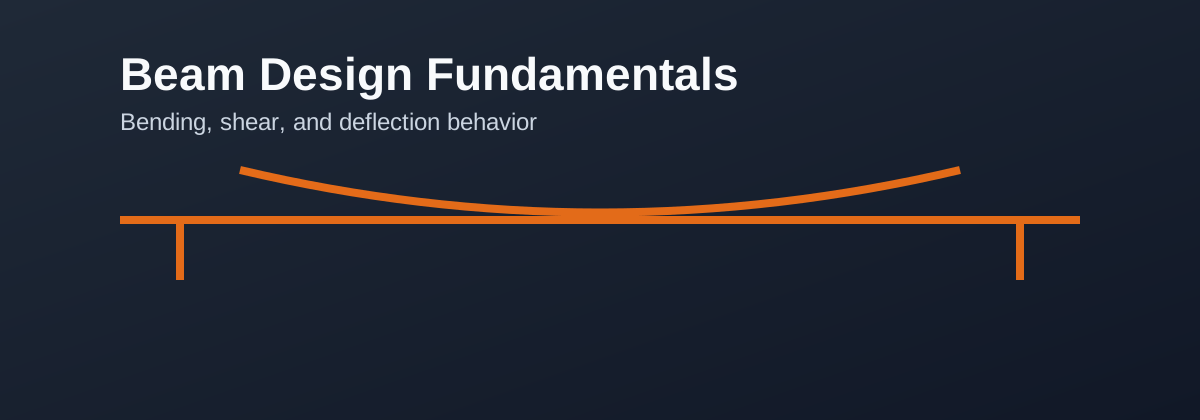
How beams resist load
Bending creates a stress gradient through the cross-section: tension at one face, compression at the other. The neutral axis carries zero bending stress. Shear forces act transversely and are largest near supports.
- Maximum bending stress σ = M·y / I where y is distance from neutral axis.
- Shear stress τ = V·Q / (I·b) peaks at the centroid, not the extreme fibre.
- For rectangular cross-sections, peak shear is 1.5 times the average.
Deflection and serviceability
Structural codes limit deflection to fractions of span (typically L/250 to L/500) to prevent damage to partitions, cracking of plaster, and user discomfort.
- Use δ = 5wL⁴/384EI for uniformly distributed loads on simply-supported beams.
- Increase section depth before increasing width— deflection scales with I.
- Consider creep factors for concrete and timber, which increase long-term deflection.
Section selection strategy
Universal beams (I-sections) are efficient because mass is concentrated in flanges away from the neutral axis, maximising I without excess weight.
- Check both moment capacity and deflection; one may govern depending on span-to-load ratio.
- Lateral torsional buckling reduces capacity for unrestrained compression flanges.
- Composite action with a concrete slab can double effective stiffness.