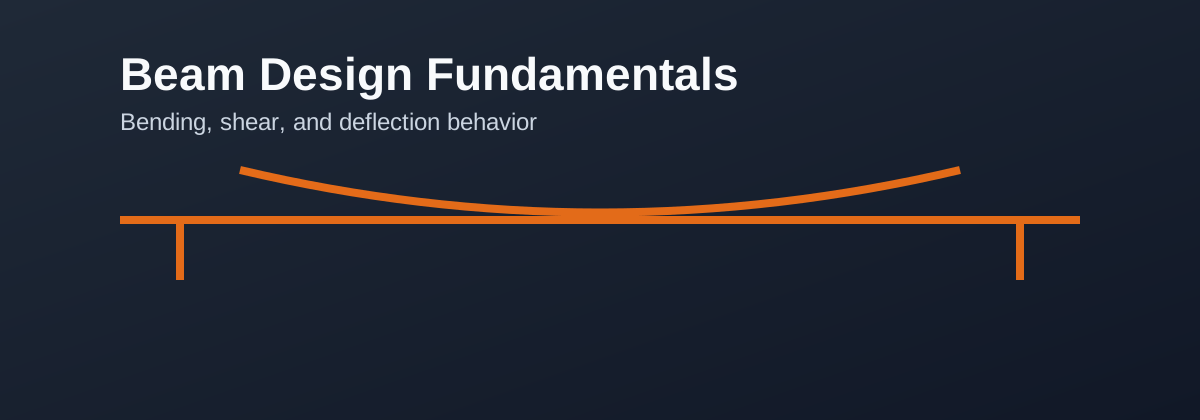
Euler-Bernoulli beam equation
The governing equation EI d²y/dx² = M(x) links curvature to bending moment. For a simply supported beam this can be integrated in closed form for standard load cases.
- EI is the flexural rigidity: Young's modulus times second moment of area.
- Deflection is downward (positive y), curvature is positive for sagging.
- The boundary conditions are y=0 at both supports (simply supported).
Superposition of load cases
Complex loadings are split into standard components whose closed-form solutions are added together. The simulator combines a central point load P and a uniformly distributed load w(x) acting simultaneously.
- Point load at position a from left: Ra = P(L−a)/L, maximum deflection near midspan.
- UDL w N/m: maximum deflection at midspan = 5wL⁴/(384EI).
- Superposition is valid because Euler-Bernoulli theory is linear.
Shear force and bending moment diagrams
The SFD is the integral of the load diagram; the BMD is the integral of the SFD. These diagrams reveal where shear and flexural capacity must be checked in design.
- Maximum shear occurs at supports; maximum moment typically at midspan for symmetric loading.
- Point loads cause sudden jumps in the SFD and kinks in the BMD.
- The location of maximum deflection coincides with where the bending moment is maximum for symmetric cases.
Serviceability limit — L/360
Most design codes limit live-load deflection to span/360 to prevent cracking of attached finishes and maintain visual flatness. The simulator flags any result exceeding this threshold.
- AS1170/Eurocode/AISC all cite L/360 as a common serviceability limit for floors.
- For roof purlins a less strict L/240 is often acceptable.
- Long-term creep deflection (typically 2× elastic) must also be checked under sustained load.