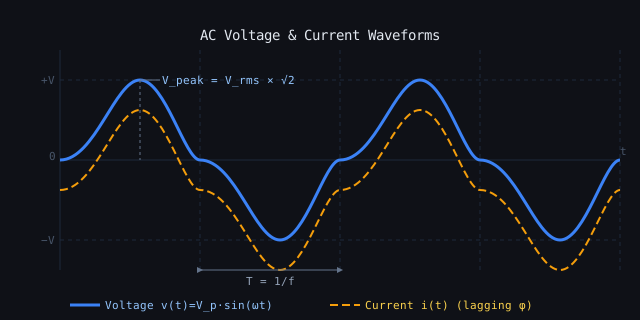
Phasors simplify AC analysis
Representing sinusoidal voltages and currents as rotating vectors (phasors) transforms differential equations into algebraic complex-number equations.
- Resistor: V and I are in phase (Z = R, angle = 0°).
- Inductor: V leads I by 90° (Z = jωL).
- Capacitor: I leads V by 90° (Z = 1/jωC = −j/ωC).
Impedance and power factor
Total impedance Z = R + jX determines the magnitude and phase of current for a given voltage. Power factor cos(θ) = R/|Z| reflects how efficiently energy is consumed.
- Unity power factor (cosθ = 1) means all apparent power is real power.
- Inductive loads (motors, transformers) draw lagging current; capacitors correct this.
- Power triangle: S² = P² + Q² where S is apparent (VA), P real (W), Q reactive (VAR).
Resonance in RLC circuits
At resonance, X_L = X_C and impedance is purely resistive. Resonant frequency ω₀ = 1/√(LC).
- Series resonance: minimum impedance, maximum current.
- Parallel resonance: maximum impedance, minimum current drawn from source.
- Q factor = ω₀L/R determines sharpness of response — critical for filter design.